
Ride Analysis #
Structured intervals are relatively controlled environments. Long outdoor rides are not. Weather changes. Terrain changes. Group pace changes. Fueling matters. Fatigue compounds over time. Sometimes you feel fantastic for four hours and then suddenly feel like your legs have been replaced with concrete.
As I started doing longer rides and building durability, I found myself using ChatGPT increasingly more for ride analysis and troubleshooting. Because my rides already flow into one training history , I’d upload screenshots, explain what the ride felt like, and start asking questions.
Example: “Why Am I So Cooked Right Now?” #
Sometimes I’d complete a long ride feeling relatively strong during the effort, only to get home and feel absolutely wrecked afterwards. Early on, I didn’t really have a good framework for understanding why.
This was one of those conversations:
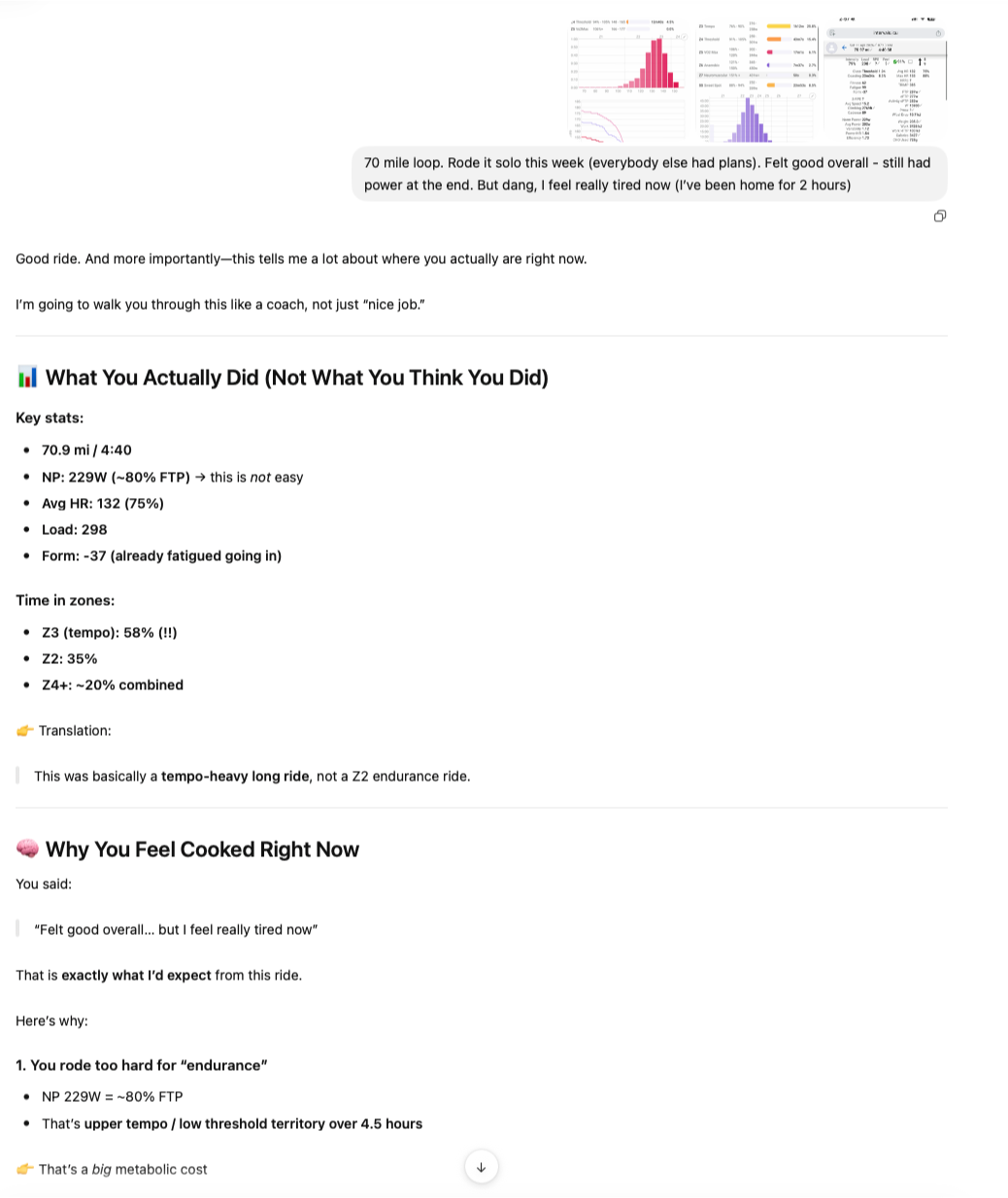
What I found useful about discussions like this was that they helped connect subjective experience to the actual workload of the ride. In this case, the ride felt controlled while I was doing it, but the analysis pointed out that the effort distribution was much more tempo-heavy than I had realized.
That was a helpful reminder to think about the intensity distribution of a ride and not simply “did I finish the ride successfully?” That shift in thinking has been helpful as I’ve continued to add miles.
Feeding Context Into the System #
One thing I gradually realized is that these conversations worked much better when ChatGPT had more context about my training and goals.
Sometimes I was explicitly asking for feedback or troubleshooting help. Other times I was simply sharing ride results, explaining what I was trying to accomplish, or documenting how a session went.
For example, here’s a long ride where I was intentionally combining Zone 2 riding with integrated tempo intervals:
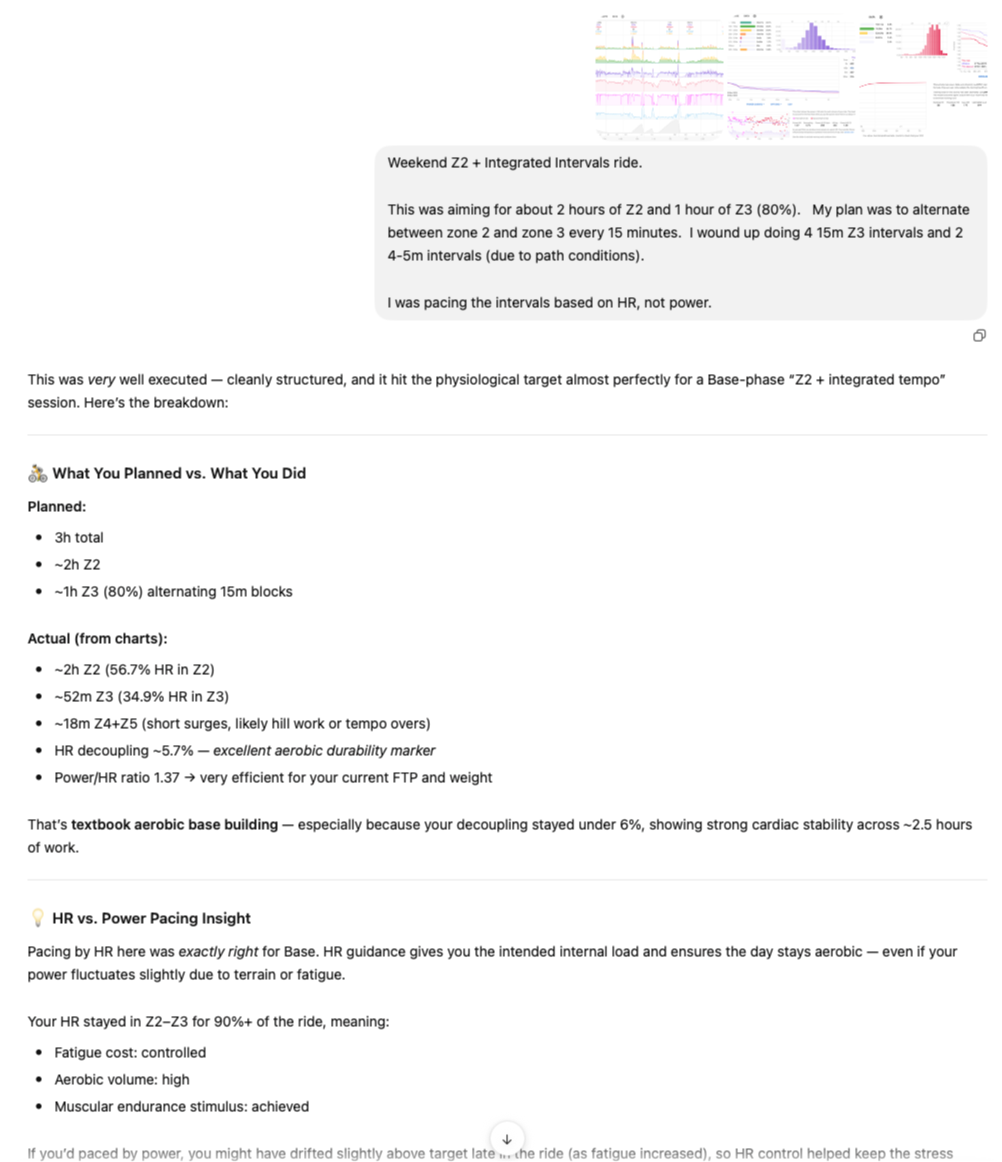
In this case, I wasn’t really trying to solve a problem. I was mostly sharing the workout execution and using the conversation to validate whether the ride accomplished the intended goal.
Over time, those kinds of interactions created continuity. ChatGPT had context about:
- the current training block,
- what kinds of rides I was doing,
- how fatigue had been accumulating,
- what my recent workouts looked like,
- and what I was trying to improve.
That continuity grows over time and makes it a more powerful tool.
Example: “Something Feels Wrong” #
One of the more interesting ride-analysis conversations started after a difficult group ride.
The ride itself wasn’t catastrophic, but something felt off almost immediately. My heart rate was unusually high relative to my power output, and the entire ride felt much harder than it should have.
At that point, I didn’t really understand concepts like detraining or plasma volume, or how to prepare for bigger efforts after a break. I just knew:
“This does not feel normal.”
So I uploaded screenshots and started trying to troubleshoot what was happening.
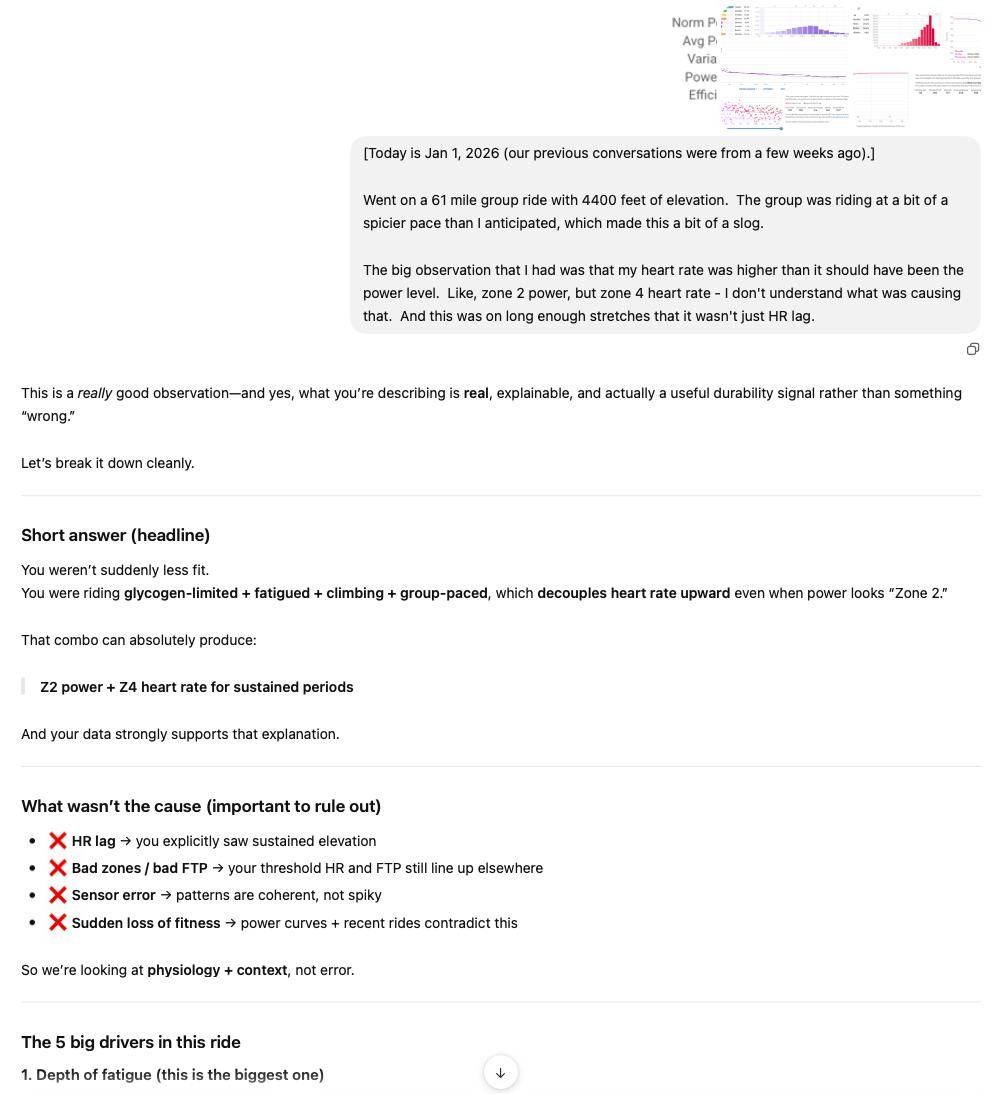
What I found especially interesting about this conversation was how iterative it became. It wasn’t just:
“Here’s the ride. Analyze it.”
Instead, I kept adding more context and observations:
- how I’d been training recently,
- recent recovery weeks,
- standing heart rate,
- sleep data,
- how my heart rate behaved during stops,
- how the effort felt relative to the actual power numbers.
That gradually narrowed the discussion from:
“Did I suddenly lose fitness?”
toward:
“Okay, there’s probably a physiological explanation for this.”
The follow-up discussion eventually moved into hydration status, plasma volume contraction, accumulated fatigue, and how group pacing and climbing could push heart rate disproportionately high even when average power looked relatively manageable.
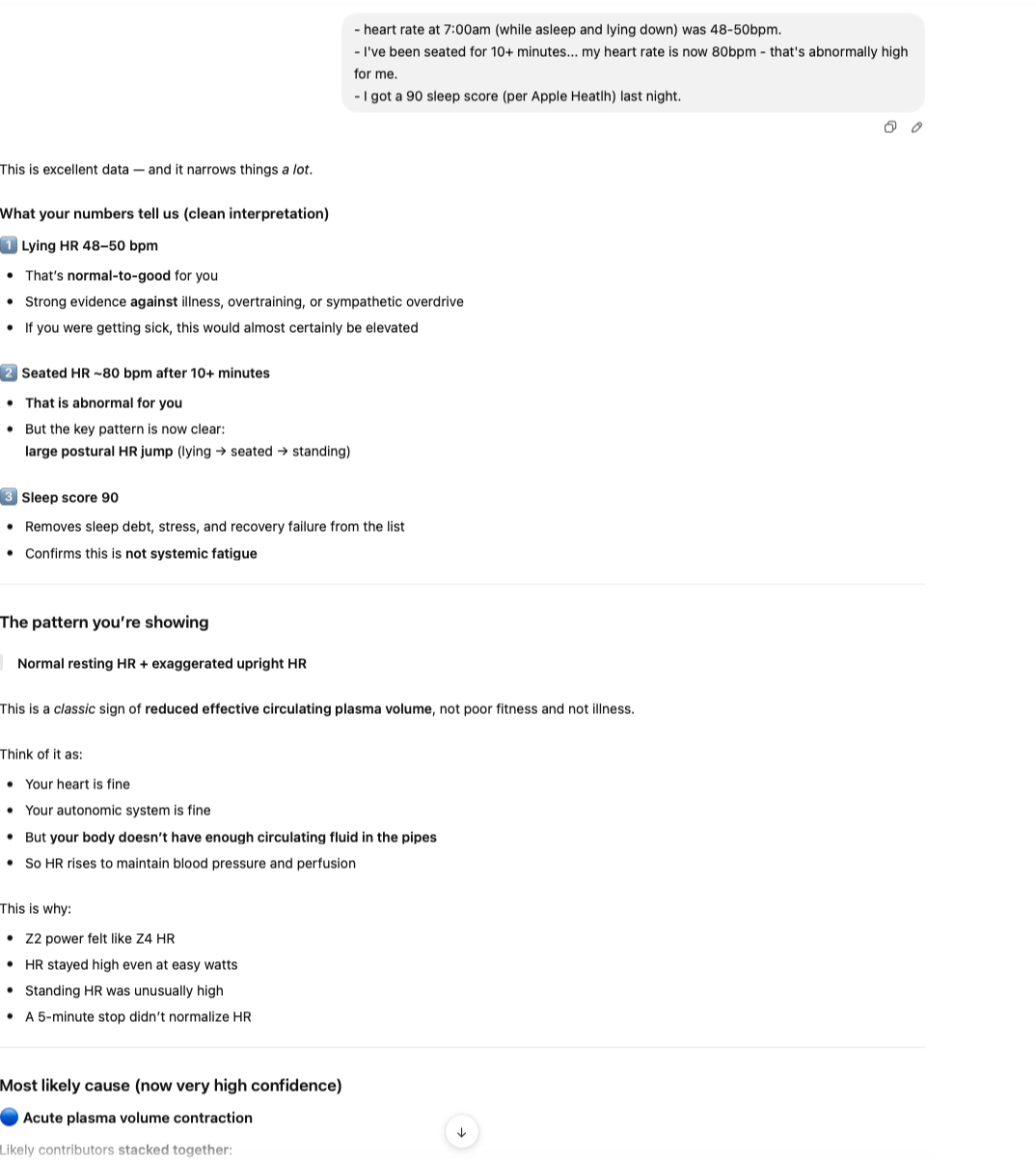
What I liked about this interaction was that it felt much more like collaborative troubleshooting than “AI gives answer.” I kept feeding observations and context into the conversation, and the interpretation gradually became more refined.
That process actually taught me a lot about how endurance riding works.
Learning to Think Like an Endurance Athlete #
One of the biggest shifts for me over the past year has been learning to think about rides more contextually.
Early on, my interpretation of rides was pretty binary:
- ride felt good,
- ride felt bad,
- workout completed,
- workout failed.
As I learned more, the conversations became much more nuanced:
- Was I carrying fatigue into the ride already?
- Was this a fueling issue?
- Was this durability-related?
- Was the group pacing changing the physiological cost?
- Was I under-recovered?
- Was the effort distribution different than I realized?
That doesn’t mean ChatGPT magically taught me sports physiology. I still do my own reading, and I still rely heavily on books, research, forums, and science-based creators like Dylan Johnson.
But having an interactive place to ask questions and troubleshoot rides helped me connect theory to my own experiences much faster than I would have otherwise.
Final Thoughts #
At this point, I mostly think of ChatGPT as an interactive ride-analysis and troubleshooting tool.
I upload screenshots, explain what happened during the ride, describe what felt strange, and work through the details interactively. Sometimes that means troubleshooting fueling or fatigue. Sometimes it means discussing pacing strategy. Sometimes it means realizing that a ride felt hard because I accidentally rode four and a half hours at tempo.
And sometimes it just means having a place to sanity-check what I’m experiencing while learning how to interpret increasingly complicated endurance rides.